


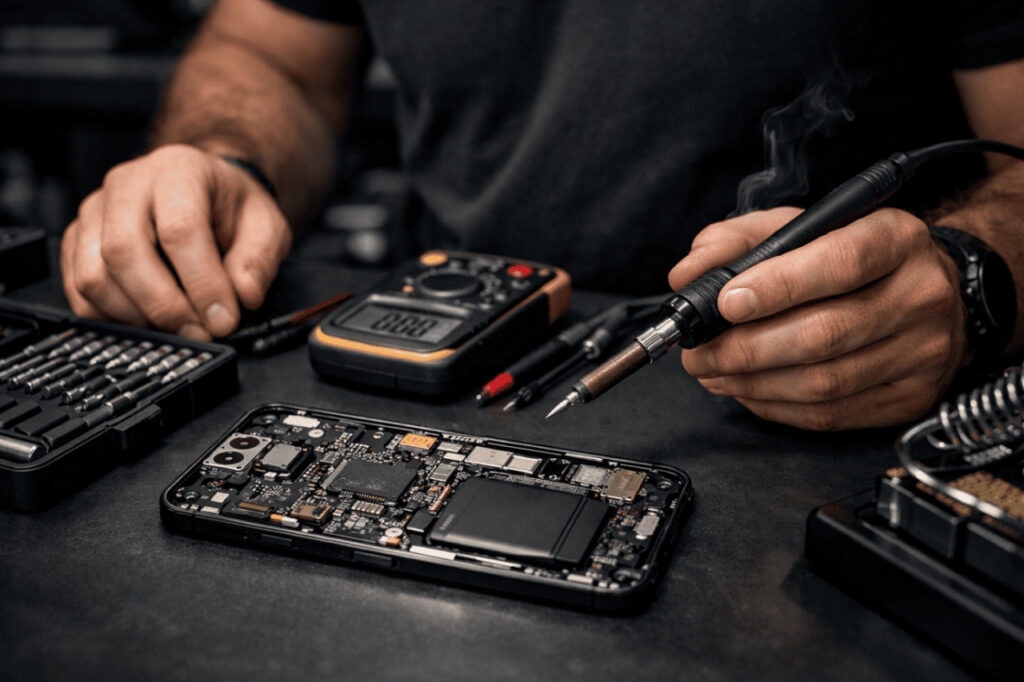
Choosing the right equipment is essential for anyone working in mobile phone repair. Whether you are setting up a new repair workstation, upgrading existing equipment, or expanding into motherboard and chip-level repair, there are several things to evaluate before making a purchase.
These 7 Factors to Consider Before Buying mobile repair tools can help technicians choose equipment based on actual repair requirements rather than simply selecting products based on price or appearance.
From soldering stations and hot air rework stations to microscopes, multimeters, PCB cleaning tools, tweezers, and precision screwdrivers, every tool has a specific purpose. Understanding what to look for can help you build a practical and reliable repair workstation.
Table of Contents
- Understand Your Repair Requirements
- Check the Specifications
- Consider Build Quality
- Look at Temperature and Airflow Control
- Check Compatibility and Accessories
- Compare Price and Long-Term Value
- Choose a Reliable Supplier
- Common Buying Mistakes
- Build Your Repair Workstation Step by Step
1. Understand Your Repair Requirements
The first of the 7 Factors to Consider Before Buying is understanding exactly what type of repair work you perform.
A technician handling basic smartphone repairs will have different equipment requirements from someone performing advanced motherboard or IC-level repairs.
For basic repairs, useful tools may include:
- Precision screwdriver sets
- Tweezers
- Opening tools
- Cleaning brushes
- Multimeters
- Battery and display repair tools
- Basic soldering equipment
For advanced repairs, technicians may also need:
- Hot air rework stations
- Soldering stations
- Digital microscopes
- DC power supplies
- PCB testers
- Precision cleaning equipment
- Specialized motherboard repair tools
Before buying, make a list of the repairs you perform regularly. This helps you invest in equipment that will actually be used.
A professional mobile repair tools supplier such as Mtools offers equipment and accessories for different types of repair requirements.
2. Check the Specifications
The second factor in these 7 Factors to Consider Before Buying is checking product specifications.
Specifications tell you what a tool is designed to do and help you compare different models.
For electronic repair equipment, pay attention to specifications such as:
- Power rating
- Temperature range
- Airflow range
- Voltage requirements
- Heating speed
- Display type
- Control system
- Operating modes
- Available accessories
For example, when purchasing a hot air rework station, don’t look only at the maximum temperature. Consider whether the station provides accurate temperature control and adjustable airflow.
Similarly, when choosing a soldering station, consider heating performance, temperature stability, compatible tips, and control options.
Understanding specifications before purchasing can prevent you from choosing equipment that does not match your repair requirements.
3. Consider Build Quality and Durability
Build quality is another important factor among the 7 Factors to Consider Before Buying mobile repair equipment.
Repair tools can be used repeatedly every day. A tool that is poorly constructed may become inconvenient or unreliable when used frequently.
When evaluating a tool, consider:
- Material quality
- Handle construction
- Switch quality
- Cable durability
- Heating element quality
- Stability
- Replacement-part availability
- Overall construction
For frequently used equipment, durability can be more important than choosing the cheapest available product.
A professional repair workstation should contain tools that can handle regular use while maintaining consistent performance.
4. Look at Temperature and Airflow Control
Temperature and airflow control are especially important when purchasing hot air rework equipment.
Different components and repair jobs may require different heat settings. Excessive heat can potentially damage sensitive components, connectors, nearby parts, or circuit-board materials.
When evaluating a hot air station, check whether it provides:
- Adjustable temperature
- Adjustable airflow
- Digital temperature display
- Stable heat output
- Suitable nozzles
- Cooling functionality
- Preset or memory settings where useful
This is one of the most important 7 Factors to Consider Before Buying a hot air rework station because control and consistency matter during precision repair work.
Technicians should also follow the equipment manufacturer’s operating instructions and use appropriate ESD precautions.
5. Check Compatibility and Accessories
A repair tool is only useful if its accessories and replacement parts are compatible.
Before purchasing equipment, check what is included in the package and what additional accessories may be required.
For example, depending on the equipment, you may need:
- Soldering tips
- Hot air nozzles
- Heating elements
- Replacement probes
- Cables
- Tweezers
- Cleaning accessories
- Spare parts
Checking accessory availability is another important part of the 7 Factors to Consider Before Buying.
A tool may have excellent specifications, but if compatible accessories are difficult to find, maintenance can become inconvenient.
You can explore mobile repair equipment and related categories through Mtools.
6. Compare Price and Long-Term Value
Price is naturally an important consideration, but it should not be the only factor.
Instead of asking only, “Which product is cheapest?”, consider how often you will use the equipment and what features you actually need.
A professional technician who uses a tool every day may benefit from investing in durable equipment with useful features and available replacement parts.
A beginner may prefer a simpler model until their repair requirements increase.
Consider the total value of the product by comparing:
- Purchase price
- Build quality
- Features
- Expected usage
- Maintenance requirements
- Replacement parts
- Accessories
- Warranty or support
- Long-term usefulness
This makes price and long-term value an important part of the 7 Factors to Consider Before Buying repair equipment.
7. Choose a Reliable Supplier
The final factor in these 7 Factors to Consider Before Buying is the supplier.
Where you purchase your repair equipment can affect product availability, accessories, replacement parts, support, and overall buying experience.
Before purchasing, check whether the supplier provides:
- Detailed product specifications
- Clear product information
- Compatible accessories
- Replacement parts
- Customer support
- Warranty information
- Shipping information
- Product-related guidance
For a repair business, having access to replacement parts and compatible accessories can be particularly useful because equipment may be used regularly.
Mtools provides mobile repair tools and equipment for technicians and repair workstations. When selecting products, compare the available specifications with your specific repair requirements rather than choosing solely based on brand or price.
Common Buying Mistakes
Knowing the 7 Factors to Consider Before Buying can help avoid several common purchasing mistakes.
Buying Only Because of a Low Price
The cheapest tool may not always provide the features, durability, or precision required for regular repair work.
Ignoring Specifications
Two products may look similar but have very different temperature control, power, airflow, or operating features.
Buying More Equipment Than You Need
A large collection of tools is not necessarily better. Start with equipment that matches your actual repair workload.
Forgetting About Accessories
Always check whether replacement tips, nozzles, probes, heating elements, or other accessories are available.
Ignoring ESD Protection
Electronic components can be sensitive to electrostatic discharge. The EOS/ESD Association recommends appropriate ESD control procedures, including suitable protective workstations, grounding, and personnel controls when handling ESD-sensitive items.
Build Your Repair Workstation Step by Step
You don’t have to purchase every tool at once.
A practical approach is to build your workstation according to your repair needs.
Start With Essential Tools
Begin with precision screwdrivers, tweezers, opening tools, cleaning equipment, a multimeter, and other basic tools required for your daily repairs.
Add Soldering Equipment
If your work involves component replacement and soldering, consider adding a suitable soldering station and related accessories.
Upgrade to Hot Air Equipment
For motherboard and component-level repair, a suitable hot air rework station can become an important part of the workstation.
Add Magnification
A microscope or suitable magnification system can help when inspecting small components and solder joints.
Improve ESD Protection
Add appropriate ESD protection to the workstation. The EOS/ESD Association describes an ESD protective workstation as incorporating elements such as a static-dissipative work surface, personnel grounding, and a common point ground.
This gradual approach can help you spend money where it provides the most practical value.
Why the Right Tools Matter
The right equipment can make repair work more organized and consistent.
Good-quality tools can help technicians:
- Work more precisely
- Reduce unnecessary delays
- Handle small components more effectively
- Maintain a cleaner workstation
- Perform testing more efficiently
- Improve workflow
- Expand the range of repair services
However, tools should always be used according to their intended purpose and manufacturer’s instructions.
Choosing suitable equipment is not about purchasing the most expensive workstation. It is about creating a setup that matches your skills, workload, repair methods, and future requirements.
Final Thoughts
There are many options available when shopping for mobile phone repair equipment, which makes careful selection important.
These 7 Factors to Consider Before Buying can provide a simple checklist: understand your repair requirements, check specifications, evaluate build quality, consider temperature and airflow control, verify compatibility, compare long-term value, and choose a reliable supplier.
Whether you are a beginner building your first repair workstation or an experienced technician upgrading your equipment, taking time to evaluate each purchase can help you create a more practical and efficient workspace.
Choose tools according to the work you actually perform, consider future repair requirements, and pay attention to accessories, replacement parts, and ESD protection.
A well-planned repair workstation is not simply a collection of tools. It is a setup designed to help you work safely, accurately, and efficiently.